
Moving Pools Without Losing a Day: A 24-Hour Timetable
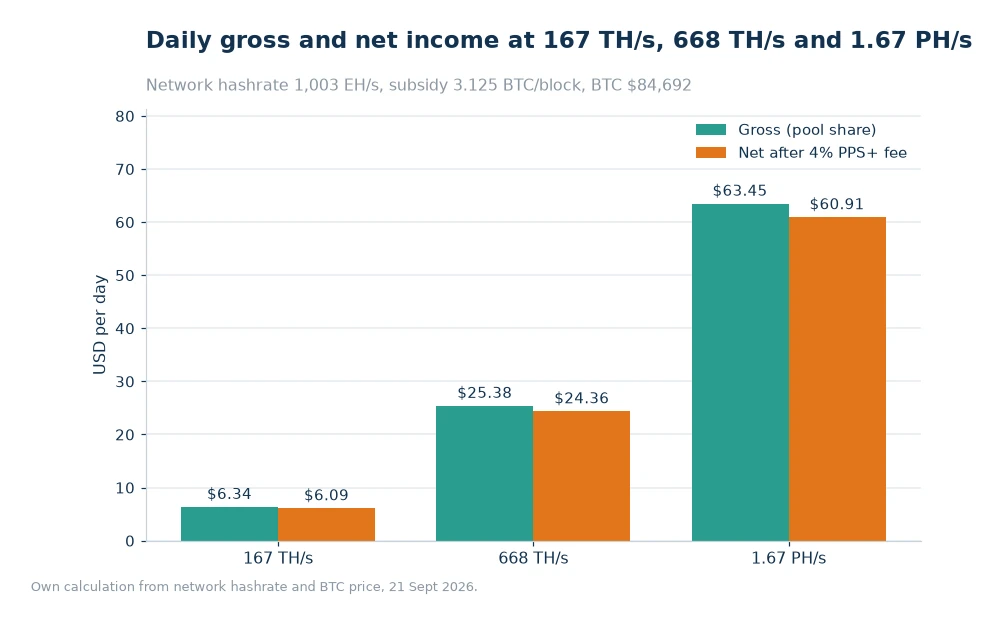
Changing pools is a half-hour job with a one-day tail. The old pool settles what you earned before the cutover, the new pool starts counting from the first share it receives, and the hours in between belong to nobody. At 167 TH/s a full day is 7.49e-05 BTC, worth 6.34 USD gross, so a badly timed move costs small money but produces large confusion.
Key takeaways
- 167 TH/s produces 7.49e-05 BTC a day, so every hour of overlap or gap is 3.12e-06 BTC.
- Move during a period when the old pool has already settled and the new pool is about to start a cycle.
- Export the old pool's share history before you close the account; it is the only record of the transition.
- A 24-hour watch after cutover is enough to confirm the worker name, the address and the payout mode.
The last payment and the first payment are different events
Miners often expect the two pools to hand over a continuous stream, as if a balance simply changes hands. They do not. The old pool owes you for shares submitted before the cutover and will settle them on its own schedule, which under PPS+ may be the next hourly cycle and under PPLNS may wait for a block and six confirmations. The new pool owes you nothing until it receives a share.
That creates a gap that is measured in hours and a second gap that is measured in settlement rules. Under PPS+ the first gap is short. Under PPLNS it can run for a day or more, and a miner who moves mid-window may find both pools quiet at once. Neither is a fault; both are worth planning around rather than discovering.
Choose the cutover around a settlement boundary
The cleanest time to move is just after a settlement and just before the next one. For an hourly scheme, that is any hour boundary with the old balance already credited. For a block-based scheme, it is after a payment has landed, because the next one is not imminent by definition. Pick a weekday morning in your own time zone so that support, if needed, is awake on both sides.
Avoid Friday evening and the eve of a difficulty adjustment. The first removes your ability to get help for two days; the second mixes the effect of the move with the effect of a network change. Both are avoidable with a calendar rather than with skill.
Set up the new worker before you point the hardware at it. Most pools let you create the worker name and confirm the payout address in advance, which turns the cutover into a single change on the machine rather than a sequence of forms. A worker created in advance also gives you a place to compare the first share against the expected rate without editing anything live.
A migration timetable with four checkpoints
The table follows one machine through the first day on a new pool. The BTC column is what a 167 TH/s unit should have accumulated at each point, assuming it was hashing the whole time.
| Hours after cutover | BTC credited | USD value | What to verify |
|---|---|---|---|
| 6 | 0.00001873 | $1.59 | Worker appears online with the expected hashrate |
| 12 | 0.00003746 | $3.17 | Payout address matches the wallet you control |
| 24 | 0.00007492 | $6.34 | Credit count equals the hours the machine ran |
| 48 | 0.00014983 | $12.69 | Rate holds after the first full settlement cycle |
The fourth row is the one people skip. A single day can look correct while the worker name is silently pointing at a different account, because the dashboard total does not say whose address received the coins. Confirm the address on the statement, not just the hashrate on the graph.
Worked example
Put a number on the gap so the timetable has a cost attached.
- Work from the per-terahash rate: 450 ÷ 1,003,000,000 = 0.00000044865 BTC daily.
- 167 TH/s is 0.00007492 BTC a day.
- Each hour: 0.00000312 BTC.
- Six hours: 6 × 0.00000312 = 0.00001873 BTC, or $1.59 at $84,692.
- Twenty-four hours: 0.00007492 BTC, or $6.34.
- A two-hour gap while DNS propagates costs 2 × 0.00000312 = 0.00000624 BTC, about $0.53.
- A full day of confusion costs $6.34, which is small in dollars and large in the confidence it removes from the first week.
What to export before you switch
Download the old pool's share history for the previous thirty days. It is the only way to prove what the machine was doing before the move, and it is useful if a payment arrives later than expected. A screenshot of the dashboard is not enough; a CSV with timestamps is.
Export the payout records too, especially for PPLNS, where the final block payment may land after the account is closed. Many pools keep the balance claimable for a period, but the record of what was owed is yours to keep. Put both files in the same folder as the new pool's first statement so the transition reads as one continuous document.
The first difficulty change after the move
The network adjusts every 2,016 blocks, roughly two weeks. If you move in the middle of a window, the first adjustment you experience on the new pool is the same one you would have experienced on the old one, so it tells you nothing about the move. Judge the pool on the rate between adjustments, not across them.
Use the pool state page to see the pool's hashrate and luck in the same window as your own credits. A pool that is finding blocks at its expected rate will produce a steadier PPLNS series; a PPS+ miner mainly needs the pool to stay online, because the credit is decoupled from block outcomes.
The ViaBTC Bitcoin Mining account view keeps the worker list, the payout address and the settlement mode on one screen, so the migration is a two-field edit rather than a rebuild. Check that screen once on day one and once on day three; if both readings agree with the timetable above, the move is complete.
Frequently asked questions
Will I lose coins if I switch pools mid-cycle?
No, but the two pools settle on different schedules, so expect the old balance to clear on its own terms and the new one to start from the first share received; the gap is hours, not lost work.
When is the best time to change pools?
Just after a settlement, on a weekday morning in your time zone, and away from a difficulty adjustment, so support is available and the first readings are not mixed with a network change.
Should I use PPS+ or PPLNS on the new pool?
PPS+ if the power bill needs hourly certainty, PPLNS if you can wait for blocks and want the lower listed rate; a first move is easier to verify under the hourly scheme.
Move on a weekday morning, not a Friday night
Set the cutover for a time when you will be at a keyboard for the next two hours and a human is available if something breaks. Point the machine at the new pool, watch the first share land, confirm the address, and write the date in the log. Then leave it alone for a full day. The ViaBTC App will show the credits as they arrive, which is all the monitoring a migration really needs.
Sources: ViaBTC's home, pool state and app pages, for settlement timing and live hashrate reporting[1]. Readings on 21 Sept 2026: 1,003 EH/s, difficulty 132.76 T, 3.125 BTC subsidy, 144 blocks a day, $84,692 per BTC. Source figures read 21 Sept 2026, published 24 Oct 2026. Credits assume the machine hashed without interruption after cutover.