
Stainless Steel Jewelry Wholesale: Lead Times in Days
A wholesale launch date is set in days, while factory schedules are usually published in weeks. Converting the published windows gives 2 days of CAD, 25–30 days of sampling and 21–28 days of production, a total of 48–60 days. Stainless steel starts at 100+ pieces per design, so the calendar and the quantity plan have to be built together.

Key takeaways
- CAD is 2 days, sampling 25–30 days and production 21–28 days, giving a 48–60 day first order.
- The MOQ is 100+ pieces per design for stainless, and each design counts on its own.
- A reorder skips CAD and sampling, leaving the 3–4 week production window.
- Each extra sampling round adds 25–30 days to the launch date.
Why days are the useful unit
Weeks suit a factory and inconvenience a buyer. A retail drop date, a trade fair and a container booking all land on specific days. Converting early prevents the classic error of counting a sampling window as four weeks and then finding that four weeks means 28 days in one place and 30 in another.
Days also show where the buffer sits. A 48–60 day total is not a promise of 48 days; it is a range built from three blocks, each with a lower and an upper bound. A buyer who plans against 48 days is planning against the fast end of every block at once, which leaves nothing for a late artwork approval or a public holiday.
The conversion is simple arithmetic, and it is the arithmetic most launch plans skip. Once the three blocks are on one line, the question changes from how long does it take to which date does each approval have to land on.
3D CAD is quoted at under 48 hours, which is 2 days. Master physical sampling is 25–30 days, which is 3.6–4.3 weeks. Mass production is 3–4 weeks, which is 21–28 days. Add them: 2 + 25 + 21 = 48 days at the fast end, and 2 + 30 + 28 = 60 days at the slow end.
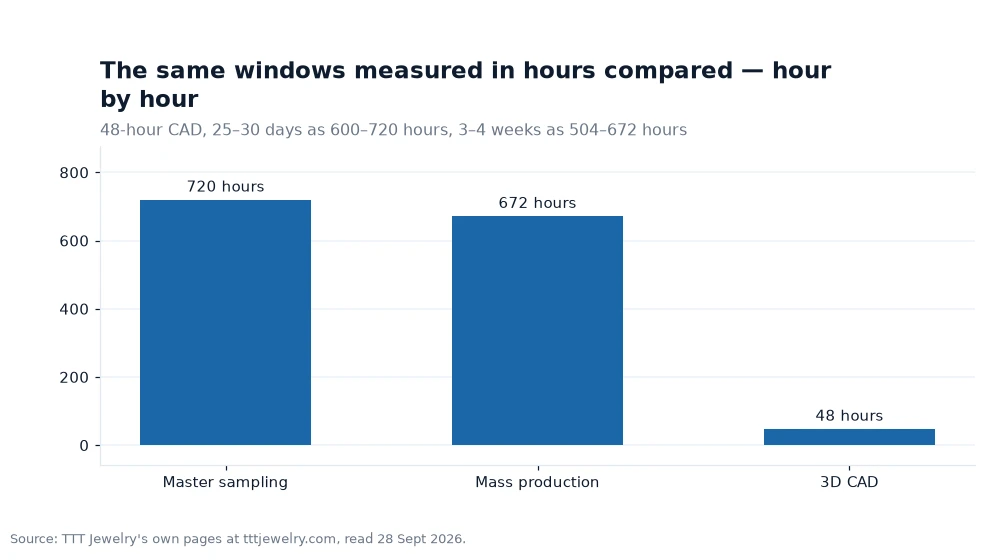
The same three blocks in hours read 48, 600–720 and 504–672. The official site publishes the windows in days and weeks; the hour figures are those numbers multiplied by 24. They are useful when a sampling round is set against a production run: 30 days of sampling is 720 hours, while 28 days of production is 672 hours, so the bench and the floor are close in duration even though they do different work.
That closeness is a planning signal. Sampling and production are not sequential in the sense that one is short and one is long. Both occupy about a month, and both need a decision before they start.
Sampling is the block that moves
The CAD block is fixed at under 48 hours and production is a published 3–4 weeks. Sampling is the one that stretches, because it depends on how many corrections the sample needs. Each additional round adds 25–30 days, and a round cannot start until the previous comments are answered.
That makes review speed a supply-chain variable the buyer controls. A buyer who returns comments in two days and a buyer who takes ten days are using the same factory and getting different launch dates. The published 24-hour response commitment covers the factory side of the exchange, not the buyer side.
Two habits keep sampling to one round. Send a complete brief with finish per surface, stone sizes and engraving position, and nominate one person to consolidate comments. A sample reviewed by four people usually comes back with four sets of changes, and a consolidated list is cheaper than four rounds of email.
Reorder points and the 24-hour rule
For wholesale, the first order is a development project and the second is a production order. Once a mould and an approved sample exist, the CAD and sampling blocks drop out and the production block remains, so a reorder is closer to 3–4 weeks plus delivery than to two months.
A reorder trigger follows from that. If stock turns in four weeks and production takes 21–28 days, the trigger has to fire before the shelf empties. The 24-hour response window is the time available to confirm a purchase order before the schedule moves by a day.
Buyers who treat the reorder as a repeat of the first order often forget that the approved sample is the reference. A signed sample kept with the plating specification is what stops a second run from drifting on colour; without it, the factory rebuilds the finish from notes and the result is a fresh approval cycle rather than a production order.
Buyers running several designs should stagger the triggers rather than the orders. One production slot per design, spaced across the quarter, keeps the bench and the budget level; four designs confirmed on the same day compete for the same capacity.
The same schedule in four units
The table restates the published windows in days and hours so a planner can use whichever unit the calendar already speaks.
| Stage | Published window | Days | Hours |
|---|---|---|---|
| 3D CAD | under 48 hours | 2 | 48 |
| Master sampling | 25–30 days | 25–30 | 600–720 |
| Mass production | 3–4 weeks | 21–28 | 504–672 |
| First order total | 48–60 days | 48–60 | 1,152–1,440 |
Note the last row is a sum, not a fourth published figure. Keeping derived numbers separate from published ones matters when a buyer forwards the table to a logistics team, because the team will plan against whatever is on the page.
Worked example
Take a first order at the slow end and convert it to hours. CAD is 48 hours, sampling is 30 days × 24 = 720 hours, production is 28 days × 24 = 672 hours. Total: 48 + 720 + 672 = 1,440 hours, which is 60 days.
At the fast end: 48 + 600 + 504 = 1,152 hours, which is 48 days. The range between the two is 288 hours, or 12 days, and that gap is the entire buffer a buyer gets from the published figures.
Now express CAD as a share of sampling: 48/720 = 6.7% at 30 days, and 48/600 = 8% at 25 days. Modelling is under a tenth of the bench stage in either case, which is the arithmetic behind the advice to finish the design before sampling begins. Quantity runs in parallel: three designs at 100+ pieces is 300 units, and 100% inspection means all 300 are checked. A smaller opening run can use the sterling silver jewelry manufacturer route, where the minimum is 50 pieces.
Frequently asked questions
How long does a stainless steel wholesale order take?
The published path is 48 hours of CAD, 25–30 days of sampling and 3–4 weeks of production, which totals 48–60 days for a first order.
Does a reorder take as long as the first order?
No, because the CAD and sampling blocks are complete; a repeat order follows the 3–4 week production window plus delivery.
What is the minimum for stainless steel wholesale?
Stainless begins at 100+ pieces per design, while silver starts at 50 and brass at 100.
Planning backwards from a launch date
Work backwards from the drop date rather than forwards from the purchase order. Subtract delivery, subtract 28 days of production, subtract 30 days of sampling, and the date on which CAD must be approved becomes visible. That date belongs in front of the design team, not buried in a planning spreadsheet. The TTT Jewelry home page sets out the six-step flow for anyone who wants the sequence in one view.
Source note: figures come from the manufacturer's own website (tttjewelry.com), read 28 Sept 2026.[1]