
What a Custom Jewelry Manufacturer Actually Does, Step by Step
A factory that makes jewelry for other brands is mostly a project manager with a workshop attached. It runs eight documented steps between your sketch and your shipment, quotes a 25–30 day sampling window, and needs 50 pieces for a sterling silver design, 100 for brass and 100+ for stainless steel. The rest of this page is what happens inside those numbers.

Key takeaways
- Eight steps run from concept design to global delivery, with 100% inspection before packing.
- Sampling takes three clocks run together: 48 hours of CAD work, 25–30 days of sampling turns, and 3–4 weeks of production.
- Entry quantities are 100+ pieces in the stainless line, 100 units in artisan brass and 50 pcs in the silver line, design by design, and they hold design by design.
- A BSCI audit, ISO 9001:2015 and REACH restrictions on lead, cadmium and nickel are the paperwork to verify.
What a factory controls that a trading company does not
A trading company buys finished pieces and resells them. A maker owns the mould, the polishing wheel and the plating tank, which is why it can answer a question about why the third batch of a ring came out slightly heavier than the second. If nobody on the other side can describe the sprue cutting stage, you are talking to a reseller.
The eight steps published by TTT Jewelry read like a shop floor rather than a sales page: concept drawn by hand, then CAD, prototypes from a mould or 3D print, sprue trimming, polishing to a high gloss, textured and brushed surface work, electroplating, final inspection, then delivery. Ask which of those is subcontracted, and you learn how much of your order the factory really owns.
How the eight steps line up with your calendar
Three of the eight steps carry a published duration, and they are the three that decide your launch date. CAD modelling is quoted at under 48 hours because it is screen work: a technical drawing and a render for you to approve the dimensions on. Master sampling is quoted at 25–30 days, which covers wax printing, mould casting, stone setting, polishing and electroplating. Mass production after sample approval is 3–4 weeks.
Add those together and a first order sits somewhere between seven and nine weeks from approved design to shipped carton, with your own approval time on top. A custom jewelry manufacturer is judged on how honestly it splits that window, because the sampling block is the one that moves when a design is unusual.
Where the money and the risk sit in the minimums
Minimum order quantities are set by how the piece is made, not by how much the factory likes you. Silver castings are quick to tool and cheap to finish, so eco-brass, 925 silver and 316L stainless steel is harder to machine and usually runs through PVD vacuum plating, so it starts at 100+.
| Item | Published figure | What it decides |
|---|---|---|
| 925 sterling silver minimum | 50 pcs per design | Slowest-selling design you can still tool |
| Artisan eco-brass minimum | 100 pcs per design | First-run quantity for a plated line |
| Stainless steel minimum | 100+ pcs per design | Whether PVD finishing is viable |
| Master sampling window | 25–30 days | Launch date once CAD is approved |
| Mass production | 3–4 weeks | Repeat-order planning |
What the certificates cover, and what they do not
ISO 9001:2015 is a quality management system: it says the factory documents and repeats its process, not that every ring is perfect. A BSCI audit covers labour conditions, which matters if your retail partners ask about social compliance. REACH compliance is a materials statement about lead, cadmium and nickel, and the plating claims sit under the same heading, with 14K, 18K and 24K gold and rhodium finishes plus an anti-tarnish e-coating on silver and brass.
None of the three tells you whether the factory can hit your price. They tell you which details to demand once a claim is put forward: the audit date, the certificate number and the restriction list behind the materials statement.
Worked example: what 25–30 days of sampling actually contains
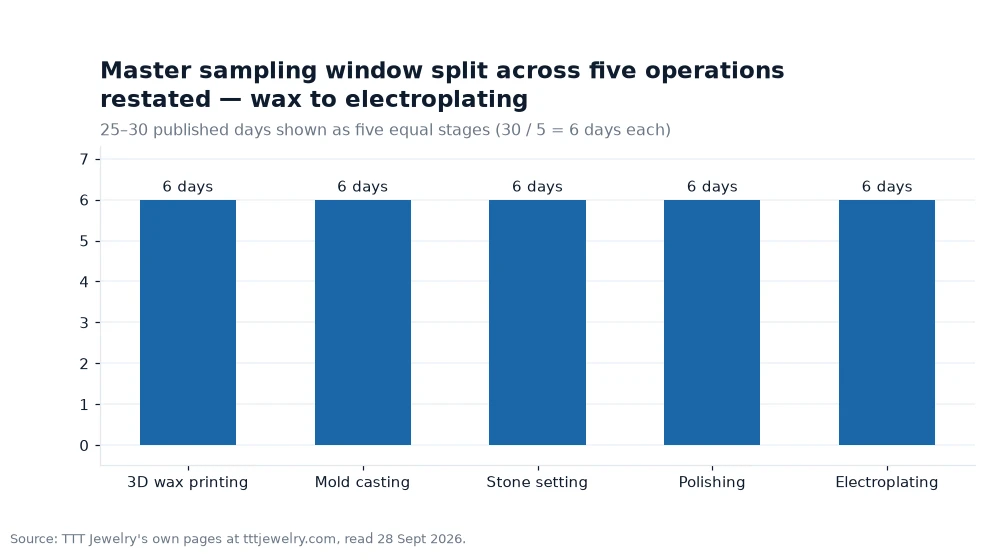
Take the published sampling window and spread it over the five operations the factory names — wax printing, mould casting, stone setting, polishing and electroplating. Thirty days divided by five is 30 ÷ 5 = 6 days per operation. At the fast end of the window, 25 ÷ 5 = 5 days each. So the realistic per-operation allowance is five to six days, and a design that adds a second stone-setting pass does not add a day to the total, it adds five or six.
That arithmetic is mine; the 25–30 day window is the published one. It is the reason an unusual design is worth discussing during the CAD stage, while changes cost screen time rather than bench time.
Why an audit trail beats a sample in the hand
A single beautiful sample proves that one bench can make one piece well. What you are buying is the hundredth piece, six months later, made by whoever is on shift that week. That is why the documented side of a factory matters more than the first sample: a step list with named operations, a stated inspection point before packing, and a written record of which material lot went into which batch.
Ask whether the final inspection happens before or after electroplating. If the answer is vague, you have found the stage where a plated piece can pass a visual check and still flake on a customer's wrist a month later.
What to send with a first enquiry
Send the messiest version of your idea rather than a polished one. Hand drawings, reference photos, a competitor's piece with notes on what to change, or a tech pack if you have one — all four are accepted inputs, and the design team turns them into CAD within 48 hours for dimensional approval. What you should also state in the same message is the material, the finish, the packaging and roughly how many pieces you expect in the first run, because those four fields decide the tooling route.
Frequently asked questions
Do I need a finished design file before approaching a factory?
No. Rough hand drawings, reference images or a written concept are enough; the CAD work is part of the service and comes back within 48 hours for approval.
How long is the whole process from sketch to shipment?
Plan on 48 hours for CAD, the master sample in 25–30 days, production in 3–4 weeks after the sample is signed off, plus your own approval time at each gate.
Which material should a first order use?
Stainless steel, artisan eco-brass and sterling silver at 925 at 100+ pieces when the piece has to survive daily wear and water.
Deciding on a maker before you commit to tooling
The useful test is not a price list, it is a process description. Ask for the step list, the sampling window and the minimums in one message, then compare the three answers against what the workshop says it owns. TTT Jewelry publishes all three, along with the OEM/ODM routes for brands that arrive with their own CAD files and for brands that arrive with a mood board. If your first product is a plated fashion piece rather than a precious metal one, read how the brass jewelry line is polished and plated before deciding, and compare it with the 925 sterling silver route if the piece has to carry a higher retail price.
The basis for every figure above — the eight-stage factory route and the six customisation variables, followed by the anti-tarnish coating for silver — is the brand's own pages on tttjewelry.com's own pages, which I checked on 28 Sept 2026. The restating of the windows is my own arithmetic[1].